Certified: The CompTIA Security+ Audio Course
By Dr. Jason Edwards
Listen to a podcast, please open Podcast Republic app. Available on Google Play Store and Apple App Store.
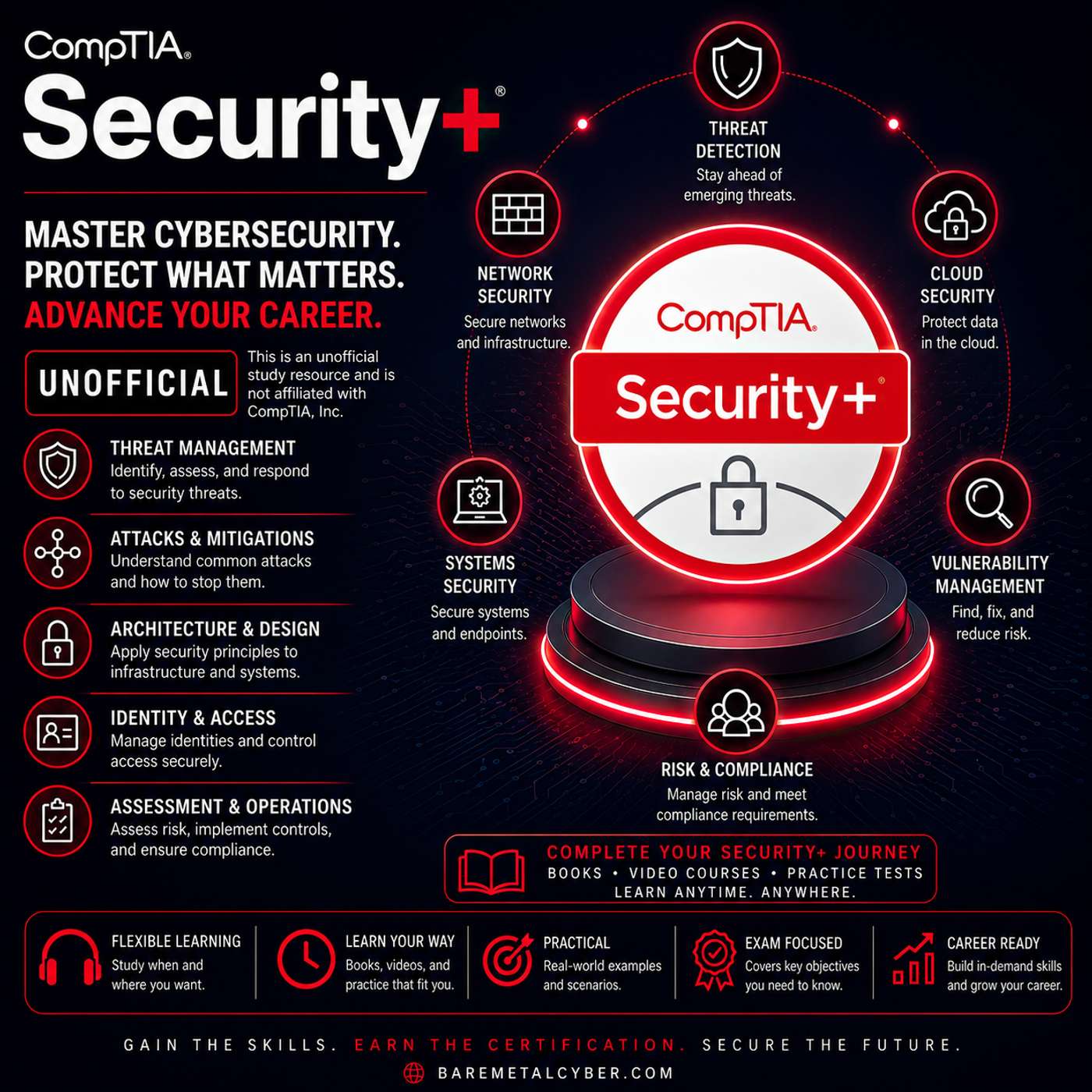
Image by Dr. Jason Edwards
Category: Technology
Open in Apple Podcasts
Open RSS feed
Open Website
Rate for this podcast
Subscribers: 8
Reviews: 0
Episodes: 340


Description
Certified - Security+ is your completely free audio companion for mastering the CompTIA Security+ certification exam. Developed by BareMetalCyber.com, this immersive Audio Course transforms every domain of the official exam objectives into clear, practical, and exam-ready lessons you can learn anywhere—whether commuting, exercising, or studying at home. Each episode delivers focused explanations, real-world examples, and proven study strategies designed to build confidence and help you pass on your first attempt. Structured for busy professionals and new learners alike, the series provides a complete, flexible way to prepare for certification success without relying on slides or handouts.
The CompTIA Security+ certification is the global benchmark for validating essential cybersecurity knowledge and hands-on skills. It covers critical areas including threat identification, risk management, network security, identity and access control, incident response, and cryptography. Designed to meet the latest industry and Department of Defense (DoD) requirements, Security+ ensures you can assess environments, implement controls, and secure systems in real-world settings. It serves as the perfect foundation for cybersecurity careers and advanced credentials like CySA+, CASP+, and C I S S P. Recognized by employers worldwide, Security+ demonstrates your readiness to protect data, defend networks, and operate confidently in modern cyber defense roles.
For a deeper study experience, pair this Audio Course with the companion textbook Achieve CompTIA Security+ SY0-701 Exam Success—the concise and complete guide designed for busy professionals preparing to earn their certification. Together, they form a powerful toolkit to help you understand, retain, and apply cybersecurity principles from day one through exam day.
| Episode | Date |
|---|---|
|
Final Objectives Update: What Changed When CompTIA Finalized SY0-801 (Update)
|
Jul 15, 2026 |
|
Full-Course Review: The SY0-801 Memory Map (Review)
|
Jul 15, 2026 |
|
PBQ Strategy: Turning Objectives into Scenario Decisions (Review)
|
Jul 15, 2026 |
|
Awareness Delivery and Effectiveness: LMS, Self-Service, Metrics, Behavior Risk Scoring, BEC, BYOD, and Remote Work (5.6)
|
Jul 15, 2026 |
|
Security Awareness Training: Onboarding, Ongoing, Targeted, and Corrective Training (5.6)
|
Jul 15, 2026 |
|
Penetration Testing, Reconnaissance, Frameworks, Functional Testing, and Behavioral Testing (5.5)
|
Jul 15, 2026 |
|
Audit Scope and Engagements: Charters, Gap Analysis, Internal Reviews, External Reviews, and Benchmarking (5.5)
|
Jul 15, 2026 |
|
Audit Data Gathering: Sampling, Questionnaires, Interviews, Assertions, and Reference Sources (5.5)
|
Jul 15, 2026 |
|
Non-Compliance, Privacy Rights, Legal Holds, Legal Orders, and Retention (5.4)
|
Jul 15, 2026 |
|
Compliance Training and Monitoring: Data Handling, AML/CTF, Anti-Bribery, and Attestations (5.4)
|
Jul 15, 2026 |
|
Vendor Constraints and Rules of Engagement: Jurisdiction, ROI, Lock-In, and Assurance Mechanisms (5.3)
|
Jul 15, 2026 |
|
Agreements and Monitoring: SLA, SLO, MOU, MOA, NDA, MSA, SOW, and Right to Audit (5.3)
|
Jul 15, 2026 |
|
Third-Party Risk: Vendor Selection, RFP, RFI, RFQ, EOI, Due Diligence, and Conflicts (5.3)
|
Jul 15, 2026 |
|
Risk Treatment and Business Impact: Transfer, Accept, Avoid, Mitigate, BIA, Appetite, Residual Risk, SLE, ALE, and ARO (5.2)
|
Jul 15, 2026 |
|
Risk Analysis and Registers: Impact, Likelihood, Owners, Current Mitigations, and Qualitative vs. Quantitative Risk (5.2)
|
Jul 15, 2026 |
|
Risk Identification and Assessment: Assets, Stakeholders, Scoring, and Categorization (5.2)
|
Jul 15, 2026 |
|
Plans and Policies: BCP, DRP, BYOD, AUP, Clean Desk, Incident Response, Data Retention, Access Control, and Privacy (5.1)
|
Jul 15, 2026 |
|
Standards and Procedures: Baselines, Passwords, Physical Security, RFCs, Encryption, SOPs, and Runbooks (5.1)
|
Jul 15, 2026 |
|
GRC Artifacts: Guidelines, Benchmarks, Advisories, Implementation Guides, and Reference Architectures (5.1)
|
Jul 15, 2026 |
|
Evidence and Stakeholders: File Integrity, Memory Dumps, Bit Copies, Snapshots, HR, Legal, and Log Parsing (4.8)
|
Jul 15, 2026 |
|
Investigation Sources: Vulnerability Scans, Automated Reports, NetFlow/IPFIX, Surveillance, and Packet Captures (4.8)
|
Jul 15, 2026 |
|
Investigation Data Types: Access, Device, Server, Application, Authentication, Communication, and Audit Logs (4.8)
|
Jul 15, 2026 |
|
Containment Through Post-Incident: Isolation, Negotiation, Recovery, Reporting, Lessons Learned, and RCA (4.7)
|
Jul 15, 2026 |
|
Identification and Investigation: Detection, Advisories, Threat Hunting, Forensics, and Chain of Custody (4.7)
|
Jul 15, 2026 |
|
Incident Response Preparation: Training, Tabletop Exercises, Playbooks, Simulations, and Roles (4.7)
|
Jul 15, 2026 |
|
AI in SecOps: Agentic AI, Chatbots, Predictive Analysis, AI-Augmented Baselines, and CI/CD (4.6)
|
Jul 15, 2026 |
|
Automation Risks and Guardrails: Logic, Complexity, Financial Risk, and Process Risk (4.6)
|
Jul 15, 2026 |
|
Automation Use Cases: Provisioning, Desired State, Anomaly Detection, and Ticketing (4.6)
|
Jul 15, 2026 |
|
Access Models and Modern Authentication: JIT Access, Passkeys, Passwordless, and Credential Monitoring (4.5)
|
Jul 15, 2026 |
|
MFA: Tokens, Biometrics, OTPs, Backup Codes, and Bypass Risks (4.5)
|
Jul 15, 2026 |
|
Account Types and Privilege Models: User, Privileged, Service, Third-Party, and Emergency Access (4.5)
|
Jul 15, 2026 |
|
Federation and SSO: SAML, LDAP, and OAuth (4.5)
|
Jul 15, 2026 |
|
IAM Lifecycle: Provisioning, Deprovisioning, Permissions, and Identity Proofing (4.5)
|
Jul 15, 2026 |
|
Monitoring Protocols and Data Flow: NetFlow, SNMP, Syslog, SCAP, Port Mirroring, and Dashboards (4.4)
|
Jul 15, 2026 |
|
Monitoring Tools: SIEM, DLP, Vulnerability Scanners, Orchestration, and Packet Analyzers (4.4)
|
Jul 15, 2026 |
|
Alerting Operations: Scanning, Archiving, Reporting, and Alert Tuning (4.4)
|
Jul 15, 2026 |
|
Monitoring Resources: Systems, Applications, Infrastructure, and Log Aggregation (4.4)
|
Jul 15, 2026 |
|
External Reporting: Bug Bounties and Responsible Disclosure (4.3)
|
Jul 15, 2026 |
|
Remediation, Verification, and Internal Reporting (4.3)
|
Jul 15, 2026 |
|
Prioritization: Severity, Business Impact, and Pen Test Report Review (4.3)
|
Jul 15, 2026 |
|
Vulnerability Management Overview: Scanning, IPAM, CSPM, and Source Code Review (4.3)
|
Jul 15, 2026 |
|
Planning, Procurement, Assignment, Tracking, Disposal, and Decommissioning (4.2)
|
Jul 15, 2026 |
|
Asset Management: Hardware, Software, and Data Life Cycle (4.2)
|
Jul 15, 2026 |
|
Email and OS Security: DMARC, SPF, DKIM, BIMI, Group Policy, and SELinux (4.1)
|
Jul 15, 2026 |
|
Repository, Application, and Code Security: Secrets Scanning, Input Validation, Secure Cookies, Static Analysis, and Code Signing (4.1)
|
Jul 15, 2026 |
|
Endpoint and Network Access Control: EDR, XDR, Antivirus, Captive Portals, 802.1X, and Posture (4.1)
|
Jul 15, 2026 |
|
Firewalls and Filtering: WAF, UTM, Layer 4/Layer 7, Rate Limiting, and DLP (4.1)
|
Jul 15, 2026 |
|
Monitoring, MDM, Allow Lists, Block Lists, IDS, IPS, and WIPS (4.1)
|
Jul 15, 2026 |
|
Deception and Disruption: Honeypots, Honeynets, Honeyfiles, Honeytokens, and Canary Accounts (4.1)
|
Jul 15, 2026 |
|
Mitigating Controls Overview: Segmentation, Access Control, Hardening, and Sandboxing (4.1)
|
Jul 15, 2026 |
|
Recovery Metrics: RTO, RPO, MTTR, and MTBF (3.4)
|
Jul 15, 2026 |
|
Disaster Recovery and Business Continuity: Failover, Simulation, Parallel Processing, and Capacity Planning (3.4)
|
Jul 15, 2026 |
|
Power, Storage, Backups, Immutability, and Restoration Testing (3.4)
|
Jul 15, 2026 |
|
Platform Diversity, Load Balancing, Clustering, Autoscaling, and High Availability (3.4)
|
Jul 15, 2026 |
|
Resilience Sites: Hot, Warm, Cold, and Environmental Planning (3.4)
|
Jul 15, 2026 |
|
Data Handling, Geofencing, Lifecycle, Retention, Disposal, and Compliance (3.3)
|
Jul 15, 2026 |
|
Data Protection Roles: Owner, Custodian, Steward, Operator, Controller, and Subprocessor (3.3)
|
Jul 15, 2026 |
|
Securing Data: Masking, Hashing, Filtering, Tokenization, Encryption, and Obfuscation (3.3)
|
Jul 15, 2026 |
|
Data Classification: Public to Top Secret, Sensitive to Restricted (3.3)
|
Jul 15, 2026 |
|
Data Types and States: Structured, Unstructured, At Rest, In Use, and In Transit (3.3)
|
Jul 15, 2026 |
|
Identity Architecture: gMSAs, Least Privilege Accounts, Privilege Creep, and Failure Modes (3.2)
|
Jul 15, 2026 |
|
Out-of-Band Management, File Transfer, and Security Service Edge (3.2)
|
Jul 15, 2026 |
|
Secure Access: VPNs, Remote Access, Tunneling, and Encrypted Messaging (3.2)
|
Jul 15, 2026 |
|
Zero Trust Architecture: User, Device, and Application Decisions (3.2)
|
Jul 15, 2026 |
|
Infrastructure Protection: Device Placement, Security Zones, Attack Surface, and Diversity (3.2)
|
Jul 15, 2026 |
|
Scalability, Environmental Requirements, Risk, and Recovery Decisions (3.1)
|
Jul 15, 2026 |
|
Business Architecture Tradeoffs: Data Sovereignty, Classification, Cost, and Ownership (3.1)
|
Jul 15, 2026 |
|
Technical Architecture Tradeoffs: Availability, Resilience, Open Source, and Usability (3.1)
|
Jul 15, 2026 |
|
OT, Air-Gapped Networks, Microservices, and Segmentation (3.1)
|
Jul 15, 2026 |
|
Serverless, Multicloud, and Infrastructure as Code (3.1)
|
Jul 15, 2026 |
|
Architecture Models: Cloud, On-Premises, Hybrid, Private, Public, and Community Cloud (3.1)
|
Jul 15, 2026 |
|
AI Abuse: Jailbreaking, Evasion, Privacy, Session Hijacking, and Code Execution (2.6)
|
Jul 15, 2026 |
|
AI Failure Risks: Data Loss, Bias, Explainability, Hallucinations, and Ethics (2.6)
|
Jul 15, 2026 |
|
AI Threats: Model Manipulation, Poisoning, and Prompt Injection (2.6)
|
Jul 15, 2026 |
|
Credential Attacks: Password Spraying, Brute Force, User Enumeration, and MFA Bypass (2.5)
|
Jul 15, 2026 |
|
Application Attacks: Injection, Buffer Overflow, Replay, Privilege Escalation, Forgery, and Traversal (2.5)
|
Jul 15, 2026 |
|
Indicators of Compromise: Hashes, Domains, Timestamps, Log Manipulation, and Impossible Travel (2.5)
|
Jul 15, 2026 |
|
Social Engineering Indicators: Smishing, Vishing, Whaling, Quishing, and Deepfakes (2.5)
|
Jul 15, 2026 |
|
Physical and Network Attack Indicators (2.5)
|
Jul 15, 2026 |
|
Malware Indicators: Ransomware, Trojans, Worms, Spyware, and Fileless Malware (2.5)
|
Jul 15, 2026 |
|
LLMs, Misconfigurations, Public Repositories, and Public Object Storage (2.4)
|
Jul 15, 2026 |
|
Stale Credentials, Rogue Devices, Shadow IT, Wireless, Mobile, and Identity Provider Risks (2.4)
|
Jul 15, 2026 |
|
Code Weaknesses: Hardcoded Secrets and Unsafe Exception Handling (2.4)
|
Jul 15, 2026 |
|
Ports, Services, Applications, Race Conditions, and Malicious Updates (2.4)
|
Jul 15, 2026 |
|
Unsupported, Unpatched, Obsolete, and Unmanaged Systems (2.4)
|
Jul 15, 2026 |
|
Supply Chain, SaaS, USB, Human, IoT, OT, Physical, Bluetooth, RF, and NFC Threats (2.3)
|
Jul 15, 2026 |
|
Network, Remote Access, and Endpoint Threat Sources (2.3)
|
Jul 15, 2026 |
|
Browser-Based Attacks: Extensions, JavaScript, Cookies, Password Managers, and Session Tokens (2.3)
|
Jul 15, 2026 |
|
Image and Attachment Attacks: QR Codes, CAPTCHA Abuse, Macros, PDFs, and RTF (2.3)
|
Jul 15, 2026 |
|
Message-Based Attacks: Email, SMS, RCS, IM, and Collaboration Tools (2.3)
|
Jul 15, 2026 |
|
APTs and the Modern Threat Vector Map (2.3)
|
Jul 15, 2026 |
|
Motivations and Capabilities: Money, Espionage, Ideology, and Extortion (2.2)
|
Jul 15, 2026 |
|
State-Sponsored, Competitors, Accidental, and Unskilled Attackers (2.2)
|
Jul 15, 2026 |
|
Threat Actors: Organized Crime, Terrorists, Hacktivists, and Insiders (2.2)
|
Jul 15, 2026 |
|
Vulnerability Types and Risk-Based Decisions (2.1)
|
Jul 15, 2026 |
|
Vulnerability Scoring: CVSS, CVEs, and Prioritization (2.1)
|
Jul 15, 2026 |
|
Threat Feeds and Intelligence Sources (2.1)
|
Jul 15, 2026 |
|
Threats vs. Vulnerabilities: Likelihood, Impact, and Life Cycle (2.1)
|
Jul 15, 2026 |
|
Hashing, Salting, Digital Signatures, Obfuscation, and Crypto Tools (1.3)
|
Jul 15, 2026 |
|
Key Exchange, Algorithms, Key Length, and Protocol Selection (1.3)
|
Jul 15, 2026 |
|
Encryption Levels: Disk, File, Volume, Database, and Record (1.3)
|
Jul 15, 2026 |
|
Symmetric vs. Asymmetric Encryption (1.3)
|
Jul 15, 2026 |
|
CSRs, Wildcards, Root of Trust, and Key Escrow (1.3)
|
Jul 15, 2026 |
|
Revocation and Validation: CRLs, OCSP, and Trust Problems (1.3)
|
Jul 15, 2026 |
|
Certificates and Certificate Authorities (1.3)
|
Jul 15, 2026 |
|
PKI Foundations: Public Keys, Private Keys, and Trust (1.3)
|
Jul 15, 2026 |
|
Technical and Documentation Impacts of Change (1.2)
|
Jul 15, 2026 |
|
Backout Plans vs. Fail Forward: Recovering from Bad Changes (1.2)
|
Jul 15, 2026 |
|
Impact Analysis, Test Results, and Maintenance Windows (1.2)
|
Jul 15, 2026 |
|
CABs, Approvals, Ownership, and Stakeholders (1.2)
|
Jul 15, 2026 |
|
Change Management: Why Security Breaks During Normal Updates (1.2)
|
Jul 15, 2026 |
|
Control Categories and Control Types (1.1)
|
Jul 15, 2026 |
|
Zero Trust Principles: Never Trust, Always Verify (1.1)
|
Jul 15, 2026 |
|
Non-Repudiation, Least Privilege, and Trust Decisions (1.1)
|
Jul 15, 2026 |
|
CIA and AAA: The Core Security Models (1.1)
|
Jul 15, 2026 |
|
Defense in Depth: Layering Controls So One Failure Doesn’t Sink You (1.1)
|
Jul 15, 2026 |
|
How to Study with an Audio-First Security+ Plan (Intro)
|
Jul 15, 2026 |
|
SY0-801 at a Glance: What Changed from Security+ 701 (Intro)
|
Jul 15, 2026 |
|
Welcome to the SEC+ Audio Course
|
Oct 14, 2025 |
|
Episode 221: Developing and Executing Security Awareness Programs (Domain 5)
|
Jun 16, 2025 |
|
Episode 220: Security Reporting and Monitoring (Domain 5)
|
Jun 16, 2025 |
|
Episode 219: Hybrid and Remote Work Security Awareness (Domain 5)
|
Jun 16, 2025 |
|
Episode 218: User Guidance and Training (Part 3) (Domain 5)
|
Jun 16, 2025 |
|
Episode 217: User Guidance and Training (Part 2) (Domain 5)
|
Jun 16, 2025 |
|
Episode 216: User Guidance and Training (Part 1) (Domain 5)
|
Jun 16, 2025 |
|
Episode 215: Anomalous Behavior Recognition (Domain 5)
|
Jun 16, 2025 |
|
Episode 214: Effective Phishing Awareness (Domain 5)
|
Jun 16, 2025 |
|
Episode 213: Reconnaissance Techniques (Domain 5)
|
Jun 16, 2025 |
|
Episode 212: Penetration Testing Environments (Domain 5)
|
Jun 16, 2025 |
|
Episode 211: Fundamentals of Penetration Testing (Domain 5)
|
Jun 16, 2025 |
|
Episode 210: External Audits and Assessments (Domain 5)
|
Jun 16, 2025 |
|
Episode 209: Internal Audit Structures (Domain 5)
|
Jun 16, 2025 |
|
Episode 208: Attestation and Internal Audits (Domain 5)
|
Jun 16, 2025 |
|
Episode 207: Data Management and Compliance (Domain 5)
|
Jun 16, 2025 |
|
Episode 206: Privacy and Legal Implications of Compliance (Domain 5)
|
Jun 16, 2025 |
|
Episode 205: Data Inventory, Retention, and the Right to Be Forgotten (Domain 5)
|
Jun 16, 2025 |
|
Episode 204: Privacy Laws and Global Compliance (Domain 5)
|
Jun 16, 2025 |
|
Episode 203: Attestation and Acknowledgement in Compliance (Domain 5)
|
Jun 16, 2025 |
|
Episode 202: Consequences of Non-Compliance (Domain 5)
|
Jun 16, 2025 |
|
Episode 201: Effective Compliance Reporting (Domain 5)
|
Jun 16, 2025 |
|
Episode 200: Ongoing Vendor Monitoring and Engagement (Domain 5)
|
Jun 16, 2025 |
|
Episode 199: Agreement Types and Contractual Security (Domain 5)
|
Jun 16, 2025 |
|
Episode 198: Vendor Risk and Supply Chain Considerations (Domain 5)
|
Jun 16, 2025 |
|
Episode 197: Mean Time Metrics and System Resilience (Domain 5)
|
Jun 16, 2025 |
|
Episode 196: Understanding Recovery Objectives (Domain 5)
|
Jun 16, 2025 |
|
Episode 195: Business Impact Analysis (Domain 5)
|
Jun 16, 2025 |
|
Episode 194: Risk Reporting and Communication (Domain 5)
|
Jun 16, 2025 |
|
Episode 193: Risk Management Strategies (Domain 5)
|
Jun 16, 2025 |
|
Episode 192: Risk Appetite, Tolerance, and Thresholds (Domain 5)
|
Jun 16, 2025 |
|
Episode 191: Risk Registers and Key Risk Indicators (Domain 5)
|
Jun 16, 2025 |
|
Episode 190: Risk Analysis and Scoring (Domain 5)
|
Jun 16, 2025 |
|
Episode 189: Conducting Risk Assessments (Domain 5)
|
Jun 16, 2025 |
|
Episode 188: Risk Management Fundamentals (Domain 5)
|
Jun 16, 2025 |
|
Episode 187: Governance Structures and Roles (Part 2) (Domain 5)
|
Jun 16, 2025 |
|
Episode 186: Governance Structures and Roles (Part 1) (Domain 5)
|
Jun 16, 2025 |
|
Episode 185: Monitoring and Revising Governance Policies (Domain 5)
|
Jun 16, 2025 |
|
Episode 184: External Security Governance Considerations (Domain 5)
|
Jun 16, 2025 |
|
Episode 183: Procedures and Playbooks (Domain 5)
|
Jun 16, 2025 |
|
Episode 182: Security Standards and Physical Controls (Domain 5)
|
Jun 16, 2025 |
|
Episode 181: Incident Response Policies and Procedures (Domain 5)
|
Jun 16, 2025 |
|
Episode 180: Key Security Policies and Standards (Domain 5)
|
Jun 16, 2025 |
|
Episode 179: Introduction to Security Governance (Domain 5)
|
Jun 16, 2025 |
|
Episode 178: Introduction to Domain Five — Security Program Management and Oversight
|
Jun 16, 2025 |
|
Episode 177: Packet Captures in Investigations (Domain 4)
|
Jun 16, 2025 |
|
Episode 176: Dashboards and Visualization Tools (Domain 4)
|
Jun 16, 2025 |
|
Episode 175: Vulnerability Scan Data and Automated Reporting (Domain 4)
|
Jun 16, 2025 |
|
Episode 174: Leveraging Log Data (Part 2) (Domain 4)
|
Jun 16, 2025 |
|
Episode 173: Leveraging Log Data (Part 1) (Domain 4)
|
Jun 16, 2025 |
|
Episode 172: Forensic Evidence Preservation and E-Discovery (Domain 4)
|
Jun 16, 2025 |
|
Episode 171: Forensics – Data Acquisition and Reporting (Domain 4)
|
Jun 16, 2025 |
|
Episode 170: Digital Forensics Foundations (Domain 4)
|
Jun 16, 2025 |
|
Episode 169: Root Cause Analysis and Threat Hunting (Domain 4)
|
Jun 16, 2025 |
|
Episode 168: Incident Response Training and Testing (Domain 4)
|
Jun 16, 2025 |
|
Episode 167: Incident Response – Lessons Learned (Domain 4)
|
Jun 16, 2025 |
|
Episode 166: Incident Response Process (Part 2) (Domain 4)
|
Jun 16, 2025 |
|
Episode 165: Incident Response Process (Part 1) (Domain 4)
|
Jun 16, 2025 |
|
Episode 164: Considerations for Security Automation (Part 2) (Domain 4)
|
Jun 16, 2025 |
|
Episode 163: Considerations for Security Automation (Part 1) (Domain 4)
|
Jun 16, 2025 |
|
Episode 162: Benefits of Security Automation (Part 2) (Domain 4)
|
Jun 16, 2025 |
|
Episode 161: Benefits of Security Automation (Part 1) (Domain 4)
|
Jun 16, 2025 |
|
Episode 160: Continuous Integration and API Automation (Domain 4)
|
Jun 16, 2025 |
|
Episode 159: Technical Debt in Automation (Domain 4)
|
Jun 16, 2025 |
|
Episode 158: Automation and Scripting in Security (Domain 4)
|
Jun 16, 2025 |
|
Episode 157: Privileged Access Management (PAM) (Domain 4)
|
Jun 16, 2025 |
|
Episode 156: Secure Password Management (Domain 4)
|
Jun 16, 2025 |
|
Episode 155: MFA Authentication Factors (Domain 4)
|
Jun 16, 2025 |
|
Episode 154: Multifactor Authentication (MFA) Implementations (Domain 4)
|
Jun 16, 2025 |
|
Episode 153: Advanced Access Controls and Least Privilege (Domain 4)
|
Jun 16, 2025 |
|
Episode 152: Access Control Models (Part 2) (Domain 4)
|
Jun 16, 2025 |
|
Episode 151: Access Control Models (Part 1) (Domain 4)
|
Jun 16, 2025 |
|
Episode 150: Interoperability and Attestation (Domain 4)
|
Jun 16, 2025 |
|
Episode 149: Single Sign-On (SSO) and Protocols (Domain 4)
|
Jun 16, 2025 |
|
Episode 148: Identity Proofing and Federation (Domain 4)
|
Jun 16, 2025 |
|
Episode 147: User Account Provisioning and Permission Management (Domain 4)
|
Jun 16, 2025 |
|
Episode 146: User Behavior Analytics (Domain 4)
|
Jun 16, 2025 |
|
Episode 145: Network Access Control and Endpoint Protection (Domain 4)
|
Jun 16, 2025 |
|
Episode 144: File Integrity Monitoring and Data Loss Prevention (Domain 4)
|
Jun 16, 2025 |
|
Episode 143: DNS Filtering and Email Security Enhancements (Domain 4)
|
Jun 16, 2025 |
|
Episode 142: Secure Protocol Implementation (Domain 4)
|
Jun 16, 2025 |
|
Episode 141: Operating System Security Enhancements (Domain 4)
|
Jun 16, 2025 |
|
Episode 140: Web Filtering and Content Security (Domain 4)
|
Jun 16, 2025 |
|
Episode 139: Enhancing IDS/IPS Effectiveness (Domain 4)
|
Jun 16, 2025 |
|
Episode 138: Enhancing Firewall Capabilities (Domain 4)
|
Jun 16, 2025 |
|
Episode 137: Vulnerability Scanning Tools and Practices (Domain 4)
|
Jun 16, 2025 |
|
Episode 136: Network-Based Monitoring Tools (Domain 4)
|
Jun 16, 2025 |
|
Episode 135: Endpoint and Data Security Monitoring Tools (Domain 4)
|
Jun 16, 2025 |
|
Episode 134: Security Monitoring Tools (Part 2) (Domain 4)
|
Jun 16, 2025 |
|
Episode 133: Security Monitoring Tools (Part 1) (Domain 4)
|
Jun 16, 2025 |
|
Episode 132: Alert Response and Validation (Domain 4)
|
Jun 16, 2025 |
|
Episode 131: Key Security Monitoring Activities (Part 2) (Domain 4)
|
Jun 16, 2025 |
|
Episode 130: Key Security Monitoring Activities (Part 1) (Domain 4)
|
Jun 16, 2025 |
|
Episode 129: Monitoring Computing Resources (Domain 4)
|
Jun 16, 2025 |
|
Episode 128: Effective Vulnerability Reporting (Domain 4)
|
Jun 16, 2025 |
|
Episode 127: Validation of Remediation Efforts (Domain 4)
|
Jun 15, 2025 |
|
Episode 126: Vulnerability Response and Remediation (Part 2) (Domain 4)
|
Jun 15, 2025 |
|
Episode 125: Vulnerability Response and Remediation (Part 1) (Domain 4)
|
Jun 15, 2025 |
|
Episode 124: Vulnerability Analysis and Prioritization (Part 2) (Domain 4)
|
Jun 15, 2025 |
|
Episode 123: Vulnerability Analysis and Prioritization (Part 1) (Domain 4)
|
Jun 15, 2025 |
|
Episode 122: System and Process Auditing (Domain 4)
|
Jun 15, 2025 |
|
Episode 121: Vulnerability Identification Methods (Part 2) (Domain 4)
|
Jun 15, 2025 |
|
Episode 120: Vulnerability Identification Methods (Part 1) (Domain 4)
|
Jun 15, 2025 |
|
Episode 119: Data Retention and Secure Management Practices (Domain 4)
|
Jun 15, 2025 |
|
Episode 118: Secure Asset Disposal and Decommissioning (Domain 4)
|
Jun 15, 2025 |
|
Episode 117: Asset Monitoring and Tracking (Domain 4)
|
Jun 15, 2025 |
|
Episode 116: Assignment, Ownership, and Classification (Domain 4)
|
Jun 15, 2025 |
|
Episode 115: Acquisition and Procurement Security (Domain 4)
|
Jun 15, 2025 |
|
Episode 114: Isolation and Monitoring Techniques (Domain 4)
|
Jun 15, 2025 |
|
Episode 113: Application Security Essentials (Domain 4)
|
Jun 15, 2025 |
|
Episode 112: Advanced Wireless Security Techniques (Domain 4)
|
Jun 15, 2025 |
|
Episode 111: Securing Mobile Connectivity (Domain 4)
|
Jun 15, 2025 |
|
Episode 110: Securing Mobile Solutions (Domain 4)
|
Jun 15, 2025 |
|
Episode 109: Securing Wireless Networks (Part 1) (Domain 4)
|
Jun 15, 2025 |
|
Episode 108: Hardening Embedded Systems and IoT Devices (Domain 4)
|
Jun 15, 2025 |
|
Episode 107: Hardening Computing Resources (Part 2) (Domain 4)
|
Jun 15, 2025 |
|
Episode 106: Hardening Computing Resources (Part 1) (Domain 4)
|
Jun 15, 2025 |
|
Episode 105: Secure Baselines and System Management (Domain 4)
|
Jun 15, 2025 |
|
Episode 104: Introduction to Domain Four — Security Operations
|
Jun 15, 2025 |
|
Episode 103: Power Resilience and Continuity (Domain 3)
|
Jun 15, 2025 |
|
Episode 102: Data Recovery Techniques (Domain 3)
|
Jun 15, 2025 |
|
Episode 101: Backup Strategies and Best Practices (Part 2) (Domain 3)
|
Jun 15, 2025 |
|
Episode 100: Backup Strategies and Best Practices (Part 1) (Domain 3)
|
Jun 15, 2025 |
|
Episode 99: Comprehensive Testing for Resilience (Domain 3)
|
Jun 15, 2025 |
|
Episode 98: Continuity of Operations and Capacity Planning (Domain 3)
|
Jun 15, 2025 |
|
Episode 97: Platform Diversity and Multi-cloud Architecture (Domain 3)
|
Jun 15, 2025 |
|
Episode 96: Disaster Recovery Site Considerations (Domain 3)
|
Jun 15, 2025 |
|
Episode 95: High Availability and System Resilience (Domain 3)
|
Jun 15, 2025 |
|
Episode 94: Methods to Secure Data (Part 3) (Domain 3)
|
Jun 15, 2025 |
|
Episode 93: Methods to Secure Data (Part 2) (Domain 3)
|
Jun 15, 2025 |
|
Episode 92: Methods to Secure Data (Part 2) (Domain 3)
|
Jun 15, 2025 |
|
Episode 91: Methods to Secure Data (Part 1) (Domain 3)
|
Jun 15, 2025 |
|
Episode 90: Data Sovereignty and Geolocation (Domain 3)
|
Jun 15, 2025 |
|
Episode 89: General Data Considerations – States of Data (Domain 3)
|
Jun 15, 2025 |
|
Episode 88: Data Classification Strategies (Part 2) (Domain 3)
|
Jun 15, 2025 |
|
Episode 87: Data Classification Strategies (Part 1) (Domain 3)
|
Jun 15, 2025 |
|
Episode 86: Human vs. Non-human Readable Data (Domain 3)
|
Jun 15, 2025 |
|
Episode 85: Data Types and Their Protection (Domain 3)
|
Jun 15, 2025 |
|
Episode 84: Selecting Effective Security Controls (Domain 3)
|
Jun 15, 2025 |
|
Episode 83: Advanced Secure Access Solutions (Domain 3)
|
Jun 15, 2025 |
|
Episode 82: Secure Communication and Remote Access (Domain 3)
|
Jun 15, 2025 |
|
Episode 81: Firewalls and Security Gateways (Domain 3)
|
Jun 15, 2025 |
|
Episode 80: Port Security and Authentication Protocols (Domain 3)
|
Jun 15, 2025 |
|
Episode 79: Load Balancers and Sensors (Domain 3)
|
Jun 15, 2025 |
|
Episode 78: Device Attributes and Network Appliances (Domain 3)
|
Jun 15, 2025 |
|
Episode 77: Connectivity and Failure Modes (Domain 3)
|
Jun 15, 2025 |
|
Episode 76: Infrastructure Security Foundations (Domain 3)
|
Jun 15, 2025 |
|
Episode 75: Architecture Security Considerations (Part 3) (Domain 3)
|
Jun 15, 2025 |
|
Episode 74: Architecture Security Considerations (Part 2) (Domain 3)
|
Jun 15, 2025 |
|
Episode 73: Architecture Security Considerations (Part 1) (Domain 3)
|
Jun 15, 2025 |
|
Episode 72: High Availability Architectures (Domain 3)
|
Jun 15, 2025 |
|
Episode 71: Specialized Architecture Models (Domain 3)
|
Jun 15, 2025 |
|
Episode 70: On-Premises, Centralized, and Decentralized Architectures (Domain 3)
|
Jun 15, 2025 |
|
Episode 69: Network Infrastructure Security Models (Domain 3)
|
Jun 15, 2025 |
|
Episode 68: Cloud Architecture and Responsibilities (Domain 3)
|
Jun 15, 2025 |
|
Episode 67: Introduction to Domain Three — Security Architecture
|
Jun 15, 2025 |
|
Episode 66: System Hardening Techniques (Part 3) (Domain 2)
|
Jun 15, 2025 |
|
Episode 65: System Hardening Techniques (Part 2) (Domain 2)
|
Jun 15, 2025 |
|
Episode 64: System Hardening Techniques (Part 1) (Domain 2)
|
Jun 15, 2025 |
|
Episode 63: Configuration Enforcement and Decommissioning (Domain 2)
|
Jun 15, 2025 |
|
Episode 62: Monitoring and Least Privilege (Domain 2)
|
Jun 15, 2025 |
|
Episode 61: Patching and Encryption (Domain 2)
|
Jun 15, 2025 |
|
Episode 60: Application Allow Lists and Isolation (Domain 2)
|
Jun 15, 2025 |
|
Episode 59: Segmentation and Access Control (Domain 2)
|
Jun 15, 2025 |
|
Episode 58: General Indicators of Malicious Activity (Domain 2)
|
Jun 15, 2025 |
|
Episode 57: Password Attack Indicators (Domain 2)
|
Jun 15, 2025 |
|
Episode 56: Cryptographic Attack Indicators (Domain 2)
|
Jun 15, 2025 |
|
Episode 55: Application-Level Attack Indicators (Domain 2)
|
Jun 15, 2025 |
|
Episode 54: Network-Based Indicators (Part 2) (Domain 2)
|
Jun 15, 2025 |
|
Episode 53: Network-Based Indicators (Part 1) (Domain 2)
|
Jun 15, 2025 |
|
Episode 52: Physical Security Attacks and Indicators (Domain 2)
|
Jun 15, 2025 |
|
Episode 51: Indicators of Malware Attacks (Domain 2)
|
Jun 15, 2025 |
|
Episode 50: Understanding Zero-Day Vulnerabilities (Domain 2)
|
Jun 15, 2025 |
|
Episode 49: Misconfiguration and Mobile Device Vulnerabilities (Domain 2)
|
Jun 15, 2025 |
|
Episode 48: Supply Chain and Cryptographic Vulnerabilities (Domain 2)
|
Jun 15, 2025 |
|
Episode 47: Virtualization and Cloud-Specific Vulnerabilities (Domain 2)
|
Jun 15, 2025 |
|
Episode 46: Hardware and Firmware Vulnerabilities (Domain 2)
|
Jun 15, 2025 |
|
Episode 45: Operating System and Web-Based Vulnerabilities (Domain 2)
|
Jun 15, 2025 |
|
Episode 44: Application-Level Vulnerabilities (Domain 2)
|
Jun 15, 2025 |
|
Episode 43: Human Vectors and Social Engineering (Part 2) (Domain 2)
|
Jun 15, 2025 |
|
Episode 42: Human Vectors and Social Engineering (Part 1) (Domain 2)
|
Jun 15, 2025 |
|
Episode 41: Open Ports, Default Credentials, and Supply Chain Risks (Domain 2)
|
Jun 15, 2025 |
|
Episode 40: Network-Based Attack Surfaces (Domain 2)
|
Jun 15, 2025 |
|
Episode 39: Vulnerable Systems, Software, and Devices (Domain 2)
|
Jun 15, 2025 |
|
Episode 38: Image, File, and Voice-Based Threats (Domain 2)
|
Jun 15, 2025 |
|
Episode 37: Message-Based and Communication Threat Vectors (Domain 2)
|
Jun 15, 2025 |
|
Episode 36: Introduction to Threat Vectors and Attack Surfaces (Domain 2)
|
Jun 15, 2025 |
|
Episode 35: Motivations Behind Cyber Attacks (Part 3) (Domain 2)
|
Jun 15, 2025 |
|
Episode 34: Motivations Behind Cyber Attacks (Part 2) (Domain 2)
|
Jun 15, 2025 |
|
Episode 33: Motivations Behind Cyber Attacks (Part 1) (Domain 2)
|
Jun 15, 2025 |
|
Episode 32: Attributes and Capabilities of Threat Actors (Domain 2)
|
Jun 15, 2025 |
|
Episode 31: Insider Threats, Organized Crime, and Shadow IT (Domain 2)
|
Jun 15, 2025 |
|
Episode 30: Understanding Threat Actors (Domain 2)
|
Jun 15, 2025 |
|
Episode 29: Introduction to Domain Two — Threats, Vulnerabilities, and Mitigations
|
Jun 15, 2025 |
|
Episode 28: Certificates, Authorities, and Management (Domain 1)
|
Jun 15, 2025 |
|
Episode 27: Advanced Cryptographic Techniques (Domain 1)
|
Jun 15, 2025 |
|
Episode 26: Hashing, Salting, and Digital Signatures (Domain 1)
|
Jun 15, 2025 |
|
Episode 25: Obfuscation and Data Protection Techniques (Domain 1)
|
Jun 15, 2025 |
|
Episode 24: Cryptographic Hardware and Secure Storage (Domain 1)
|
Jun 15, 2025 |
|
Episode 23: Comprehensive Encryption Techniques (Domain 1)
|
Jun 15, 2025 |
|
Episode 22: Introduction to Cryptography and PKI (Domain 1)
|
Jun 15, 2025 |
|
Episode 21: Documentation and Version Control (Domain 1)
|
Jun 15, 2025 |
|
Episode 20: Technical Implications of Change Management (Domain 1)
|
Jun 15, 2025 |
|
Episode 19: Effective Implementation and Maintenance in Change Management (Domain 1)
|
Jun 15, 2025 |
|
Episode 18: Business Processes in Change Management (Domain 1)
|
Jun 15, 2025 |
|
Episode 17: Introduction to Change Management (Domain 1)
|
Jun 15, 2025 |
|
Episode 16: Deception and Disruption Technologies (Domain 1)
|
Jun 15, 2025 |
|
Episode 15: Physical Security Essentials (Domain 1)
|
Jun 15, 2025 |
|
Episode 14: Gap Analysis and Zero Trust Security (Domain 1)
|
Jun 15, 2025 |
|
Episode 13: Non-Repudiation and AAA (Authentication, Authorization, Accounting) (Domain 1)
|
Jun 15, 2025 |
|
Episode 12: Confidentiality, Integrity, and Availability (CIA Triad) (Domain 1)
|
Jun 15, 2025 |
|
Episode 11: Compensating and Directive Controls (Domain 1)
|
Jun 15, 2025 |
|
Episode 10: Security Control Types Explained (Part 2) (Domain 1)
|
Jun 15, 2025 |
|
Episode 9: Security Control Types Explained (Part 1) (Domain 1)
|
Jun 15, 2025 |
|
Episode 8: Physical Controls and Their Implementation (Domain 1)
|
Jun 15, 2025 |
|
Episode 7: Security Control Categories Deep Dive (Domain 1)
|
Jun 15, 2025 |
|
Episode 6: Introduction to Security Controls (Domain 1)
|
Jun 15, 2025 |
|
Episode 5: Introduction to Domain One — General Security Concepts
|
Jun 15, 2025 |
|
Episode 4: What to Expect on Exam Day—and Beyond
|
Jun 15, 2025 |
|
Episode 3: Preparing for the Security Plus Exam: Study Strategies That Work
|
Jun 15, 2025 |
|
Episode 2: How the Security Plus SY0-701 Exam Is Organized
|
Jun 15, 2025 |
|
Episode 1: What Is the CompTIA Security Plus Certification?
|
Jun 15, 2025 |