Certified: The CompTIA DataX Audio Course
By Dr. Jason Edwards
Listen to a podcast, please open Podcast Republic app. Available on Google Play Store and Apple App Store.
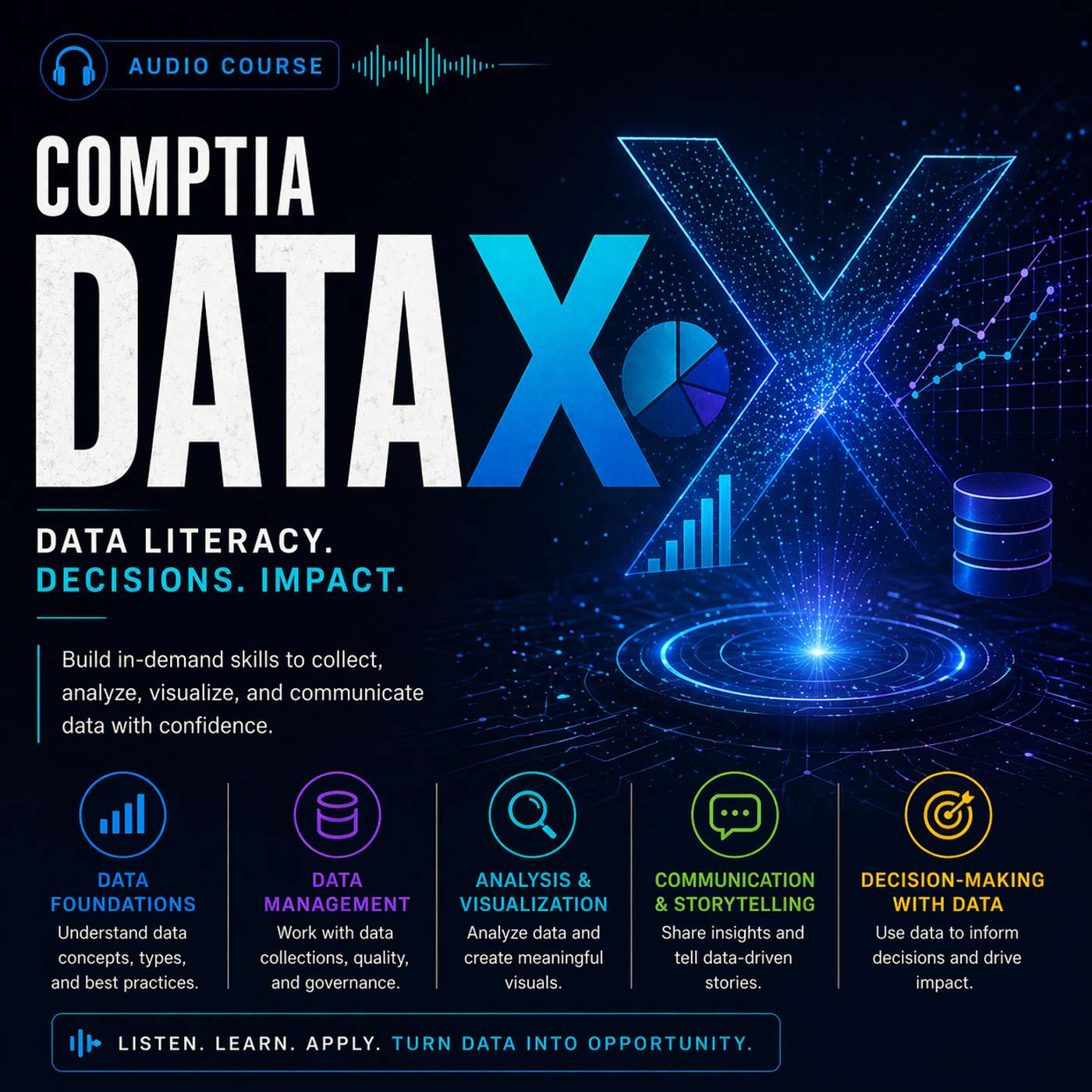
Image by Dr. Jason Edwards
Category: Technology
Open in Apple Podcasts
Open RSS feed
Open Website
Rate for this podcast
Subscribers: 0
Reviews: 0
Episodes: 121


Description
This DataX DY0-001 PrepCast is an exam-focused, audio-first course designed to train analytical judgment rather than rote memorization, guiding you through the full scope of the CompTIA DataX exam exactly the way the test expects you to think. The course builds from statistical and mathematical foundations into exploratory analysis, feature design, modeling, machine learning, and business integration, with each episode reinforcing how to interpret scenarios, recognize constraints, select defensible methods, and avoid common traps such as leakage, metric misuse, and misaligned objectives. Concepts are explained in clear, structured language without reliance on visuals, code, or tools, making the material accessible during commutes or focused listening sessions while still remaining technically precise and exam-relevant. Throughout the series, emphasis is placed on decision-making under uncertainty, operational realism, governance and compliance considerations, and translating analytical results into business-aligned outcomes, ensuring you are prepared not only to answer DataX questions correctly, but to justify why the chosen answer is the best next step in real-world data and analytics environments.
| Episode | Date |
|---|---|
|
Episode 120 — Ingestion and Storage: Formats, Structured vs Unstructured, and Pipeline Choices
|
Jan 24, 2026 |
|
Episode 119 — External and Commercial Data: Availability, Licensing, and Restrictions
|
Jan 24, 2026 |
|
Episode 118 — Data Acquisition: Surveys, Sensors, Transactions, Experiments, and DGP Thinking
|
Jan 24, 2026 |
|
Episode 117 — Compliance and Privacy: PII, Proprietary Data, and Risk-Aware Handling
|
Jan 24, 2026 |
|
Episode 116 — Business Alignment: Requirements, KPIs, and “Need vs Want” Tradeoffs
|
Jan 24, 2026 |
|
Episode 115 — Domain 3 Mixed Review: Model Selection and ML Scenario Drills
|
Jan 24, 2026 |
|
Episode 114 — Recommenders: Similarity, Collaborative Filtering, and ALS in Plain Terms
|
Jan 24, 2026 |
|
Episode 113 — SVD and Nearest Neighbors: Where They Appear in DataX Scenarios
|
Jan 24, 2026 |
|
Episode 112 — Nonlinear Reduction: t-SNE and UMAP for Structure, Not “Truth”
|
Jan 24, 2026 |
|
Episode 111 — Dimensionality Reduction: PCA Intuition and What Components Represent
|
Jan 24, 2026 |
|
Episode 110 — Cluster Validation: Elbow, Silhouette, and “Does This Grouping Matter”
|
Jan 24, 2026 |
|
Episode 109 — Clustering: k-Means, Hierarchical, DBSCAN and Choosing the Right One
|
Jan 24, 2026 |
|
Episode 108 — AutoML and Few-Shot Concepts: Where Automation Fits and Where It Fails
|
Jan 24, 2026 |
|
Episode 107 — Transfer Learning and Embeddings: Reuse, Fine-Tune, and Cold Start
|
Jan 24, 2026 |
|
Episode 106 — Deep Model Families: CNN, RNN, LSTM, Autoencoders, GANs, Transformers
|
Jan 24, 2026 |
|
Episode 105 — Regularizing Deep Models: Dropout, Batch Norm, Early Stopping, Schedulers
|
Jan 24, 2026 |
|
Episode 104 — Optimizers: SGD, Momentum, Adam, RMSprop and Practical Differences
|
Jan 24, 2026 |
|
Episode 103 — Training Mechanics: Backpropagation as Error Correction
|
Jan 24, 2026 |
|
Episode 102 — Activation Functions: ReLU, Sigmoid, Tanh, Softmax and Output Behavior
|
Jan 24, 2026 |
|
Episode 101 — Neural Network Basics: Neurons, Layers, and What “Representation” Means
|
Jan 24, 2026 |
|
Episode 100 — Ensemble Thinking: When Combining Models Helps and When It Confuses
|
Jan 24, 2026 |
|
Episode 99 — Boosting: Gradient Boosting and Why XGBoost Often Wins
|
Jan 24, 2026 |
|
Episode 98 — Random Forests: Bagging Intuition and Variance Reduction
|
Jan 24, 2026 |
|
Episode 97 — Decision Trees: Splits, Depth, Pruning, and Interpretability Tradeoffs
|
Jan 24, 2026 |
|
Episode 96 — Association Rules: Support, Confidence, Lift, and Practical Meaning
|
Jan 24, 2026 |
|
Episode 95 — Naive Bayes: When Simple Probabilistic Models Shine
|
Jan 24, 2026 |
|
Episode 94 — LDA vs QDA: Choosing Discriminant Methods by Data Shape
|
Jan 24, 2026 |
|
Episode 93 — Logit vs Probit: Recognizing Differences Without Overcomplicating It
|
Jan 24, 2026 |
|
Episode 92 — Logistic Regression: Probabilities, Log-Odds, and Threshold Strategy
|
Jan 24, 2026 |
|
Episode 91 — Weighted Least Squares: Handling Non-Constant Variance in Regression
|
Jan 24, 2026 |
|
Episode 90 — OLS Assumptions: What Violations Look Like in Real Problems
|
Jan 24, 2026 |
|
Episode 89 — Regression Families: When Linear Regression Is Appropriate
|
Jan 24, 2026 |
|
Episode 88 — Explainability: Global vs Local and Interpretable vs Post-Hoc
|
Jan 24, 2026 |
|
Episode 87 — Drift Types: Data Drift vs Concept Drift and Expected Warning Signs
|
Jan 24, 2026 |
|
Episode 86 — Data Leakage: “Too Good to Be True” Results and How to Catch Them
|
Jan 24, 2026 |
|
Episode 85 — Generalization: In-Sample vs Out-of-Sample and Interpolation vs Extrapolation
|
Jan 24, 2026 |
|
Episode 84 — SMOTE and Resampling: When Synthetic Examples Help or Harm
|
Jan 24, 2026 |
|
Episode 83 — Class Imbalance: Why It Breaks Metrics and How to Fix Decisions
|
Jan 24, 2026 |
|
Episode 82 — Hyperparameter Tuning: Grid vs Random vs Practical Constraints
|
Jan 24, 2026 |
|
Episode 81 — Cross-Validation: k-Fold Logic and Common Misinterpretations
|
Jan 24, 2026 |
|
Episode 80 — Regularization: Ridge, LASSO, Elastic Net as Control Knobs
|
Jan 24, 2026 |
|
Episode 79 — Bias-Variance Tradeoff: Diagnosing Overfitting and Underfitting by Symptoms
|
Jan 24, 2026 |
|
Episode 78 — ML Core Concepts: Learning, Loss, and What “Optimization” Really Means
|
Jan 24, 2026 |
|
Episode 77 — Domain 2 Mixed Review: EDA, Features, and Modeling Outcomes Drills
|
Jan 24, 2026 |
|
Episode 76 — Documentation Essentials: Data Dictionary, Metadata, and Change Tracking
|
Jan 24, 2026 |
|
Episode 75 — Communicating Results: Clear Narratives, Honest Limitations, and Accessibility
|
Jan 24, 2026 |
|
Episode 74 — Validation Hygiene: Data Splits, Leakage Prevention, and Reproducibility
|
Jan 24, 2026 |
|
Episode 73 — Residual Thinking: Diagnosing What Your Model Still Can’t Explain
|
Jan 24, 2026 |
|
Episode 72 — Training Cost vs Inference Cost: Choosing Models for the Real World
|
Jan 24, 2026 |
|
Episode 71 — Metric Selection by Goal: Aligning Measures With Business Outcomes
|
Jan 24, 2026 |
|
Episode 70 — Iteration Loops: From Constraints to Experiments to Better Outcomes
|
Jan 24, 2026 |
|
Episode 69 — Designing the First Model: Baselines, Assumptions, and Quick Wins
|
Jan 24, 2026 |
|
Episode 68 — Synthetic Data: Why It’s Used, How It’s Sampled, and Where It Misleads
|
Jan 24, 2026 |
|
Episode 67 — Geocoding as Enrichment: Location Features With Realistic Expectations
|
Jan 24, 2026 |
|
Episode 66 — Feature Reshaping: Ratios, Aggregations, and Pivoting Concepts
|
Jan 24, 2026 |
|
Episode 65 — Discretization Choices: Binning for Interpretability and Model Stability
|
Jan 24, 2026 |
|
Episode 64 — Scaling Choices: Normalization vs Standardization vs Robust Scaling
|
Jan 24, 2026 |
|
Episode 63 — Box-Cox and Friends: Transformations for Shape and Variance Control
|
Jan 24, 2026 |
|
Episode 62 — Linearization Tactics: Log, Exp, and Interpreting the New Scale
|
Jan 24, 2026 |
|
Episode 61 — Interaction Features: Cross-Terms and When They Actually Help
|
Jan 24, 2026 |
|
Episode 60 — Encoding Categorical Data: One-Hot vs Label Encoding Tradeoffs
|
Jan 24, 2026 |
|
Episode 59 — Enrichment Strategy: New Sources vs Better Features vs Better Labels
|
Jan 24, 2026 |
|
Episode 58 — Outliers in Context: Univariate vs Multivariate and Why They Break Assumptions
|
Jan 24, 2026 |
|
Episode 57 — Weak Features and Insufficient Signal: When Better Modeling Won’t Save You
|
Jan 24, 2026 |
|
Episode 56 — Multicollinearity: How to Spot It and What to Do About It
|
Jan 24, 2026 |
|
Episode 55 — Seasonality and Granularity: Fixing “Wrong Time Scale” Analysis
|
Jan 24, 2026 |
|
Episode 54 — Non-Stationarity Beyond Time Series: Drifting Patterns in Real Systems
|
Jan 24, 2026 |
|
Episode 53 — Nonlinearity in Data: Detecting It and Knowing When Linear Models Fail
|
Jan 24, 2026 |
|
Episode 52 — Sparse Data and High Dimensionality: Symptoms and Mitigations
|
Jan 24, 2026 |
|
Episode 51 — Data Quality Problems: Missingness, Noise, Duplicates, and Inconsistency
|
Jan 24, 2026 |
|
Episode 50 — Chart Literacy Without Charts: What Patterns Sound Like in Words
|
Jan 24, 2026 |
|
Episode 49 — Multivariate Analysis Narration: Relationships, Interactions, and Confounding
|
Jan 24, 2026 |
|
Episode 48 — Univariate Analysis Narration: Distributions, Outliers, and “Typical” Behavior
|
Jan 24, 2026 |
|
Episode 47 — Feature Types: Categorical, Ordinal, Continuous, Binary, and Why Choices Change
|
Jan 24, 2026 |
|
Episode 46 — EDA Mindset: What You Look For Before You Model Anything
|
Jan 24, 2026 |
|
Episode 45 — Domain 1 Mixed Review: Statistics and Math Decision Drills
|
Jan 24, 2026 |
|
Episode 44 — A/B Tests and RCTs: Treatment Effects, Validity, and Common Pitfalls
|
Jan 24, 2026 |
|
Episode 43 — Difference-in-Differences: Detecting Change When You Can’t Randomize
|
Jan 24, 2026 |
|
Episode 42 — Causal Tools: DAGs as a Way to Explain “What Drives What”
|
Jan 24, 2026 |
|
Episode 41 — Causal Thinking: Correlation vs Causation and Why the Exam Cares
|
Jan 24, 2026 |
|
Episode 40 — Parametric vs Non-Parametric Survival: When Assumptions Help or Hurt
|
Jan 24, 2026 |
|
Episode 39 — Survival Analysis Concepts: What “Time to Event” Modeling Solves
|
Jan 24, 2026 |
|
Episode 38 — Differencing and Lag Features: Fixing Non-Stationarity Without Overfitting
|
Jan 24, 2026 |
|
Episode 37 — AR, MA, and ARIMA: Choosing the Right Time Series Family
|
Jan 24, 2026 |
|
Episode 36 — Time Series Basics: Trend, Seasonality, Noise, and Stationarity
|
Jan 24, 2026 |
|
Episode 35 — Logs and Exponentials: Why They Show Up in Models and Transformations
|
Jan 24, 2026 |
|
Episode 34 — Calculus for ML: Derivatives as “Slope,” Partial Derivatives, and the Chain Rule
|
Jan 24, 2026 |
|
Episode 33 — Distance and Similarity Metrics: Euclidean, Manhattan, Cosine, and When to Use
|
Jan 24, 2026 |
|
Episode 32 — Eigenvalues and Eigenvectors: The Intuition Behind “Important Directions”
|
Jan 24, 2026 |
|
Episode 31 — Matrix Operations You Must Understand: Multiply, Transpose, Invert, Decompose
|
Jan 24, 2026 |
|
Episode 30 — Math for Modeling: Vectors, Matrices, and What Linear Algebra Enables
|
Jan 24, 2026 |
|
Episode 29 — Sampling Strategies: Stratification, Oversampling, and Class Balance
|
Jan 24, 2026 |
|
Episode 28 — Missing Data Types: MCAR vs MAR vs NMAR and Correct Responses
|
Jan 24, 2026 |
|
Episode 27 — Resampling Methods: Bootstrapping for Confidence Without New Data
|
Jan 24, 2026 |
|
Episode 26 — Simulation Thinking: Monte Carlo for Uncertainty and Risk
|
Jan 24, 2026 |
|
Episode 25 — PDF, PMF, and CDF: The Three Views of Probability You Must Recognize
|
Jan 24, 2026 |
|
Episode 24 — Variance Behavior: Homoskedasticity vs Heteroskedasticity and Why It Matters
|
Jan 24, 2026 |
|
Episode 23 — Shape Descriptors: Skewness and Kurtosis as “Data Personality”
|
Jan 24, 2026 |
|
Episode 22 — Real-World Distributions: Skew, Heavy Tails, and Power Laws
|
Jan 24, 2026 |
|
Episode 21 — Distribution Families: Normal, Uniform, Binomial, Poisson, and t-Distribution
|
Jan 24, 2026 |
|
Episode 20 — Bayes’ Rule in Plain English: Updating Beliefs With Evidence
|
Jan 24, 2026 |
|
Episode 19 — Probability Essentials: Events, Conditional Probability, and Independence
|
Jan 24, 2026 |
|
Episode 18 — Law of Large Numbers: Stability, Variance, and Practical Implications
|
Jan 24, 2026 |
|
Episode 17 — Central Limit Theorem: Why Averages Behave and When They Don’t
|
Jan 24, 2026 |
|
Episode 16 — Model Comparison Criteria: AIC, BIC, and Parsimony Without Hand-Waving
|
Jan 24, 2026 |
|
Episode 15 — Thresholding and Tradeoffs: ROC Curves, AUC, and Operating Points
|
Jan 24, 2026 |
|
Episode 14 — Precision, Recall, F1, and When Accuracy Lies
|
Jan 24, 2026 |
|
Episode 13 — Classification Evaluation: Confusion Matrix Thinking Under Pressure
|
Jan 24, 2026 |
|
Episode 12 — Regression Evaluation: R², Adjusted R², RMSE, and Residual Intuition
|
Jan 24, 2026 |
|
Episode 11 — Correlation and Association: Pearson vs Spearman vs “No Relationship”
|
Jan 24, 2026 |
|
Episode 10 — Selecting Tests: t-Test vs Chi-Squared vs ANOVA in Scenarios
|
Jan 24, 2026 |
|
Episode 9 — Confidence Intervals: Interpretation, Width, and Common Traps
|
Jan 24, 2026 |
|
Episode 8 — Type I vs Type II Errors and Why Power Matters in Decisions
|
Jan 24, 2026 |
|
Episode 7 — Hypothesis Testing Basics: Null, Alternative, and What p-Values Really Mean
|
Jan 24, 2026 |
|
Episode 6 — Statistical Foundations: Populations, Samples, Parameters, and Estimates
|
Jan 24, 2026 |
|
Episode 5 — The Data Science Lifecycle at Exam Level: From Problem to Production
|
Jan 24, 2026 |
|
Episode 4 — Performance-Based Questions in Audio: How to Think Without a Keyboard
|
Jan 24, 2026 |
|
Episode 3 — Reading the Prompt Like an Analyst: Keywords, Constraints, and “Best Next Step”
|
Jan 24, 2026 |
|
Episode 2 — How CompTIA DataX Questions Are Built and What They Reward
|
Jan 24, 2026 |
|
Episode 1 — Welcome to DataX DY0-001 and How This Audio Course Works
|
Jan 24, 2026 |
|
Welcome to the DataX Audio Course
|
Jan 24, 2026 |